
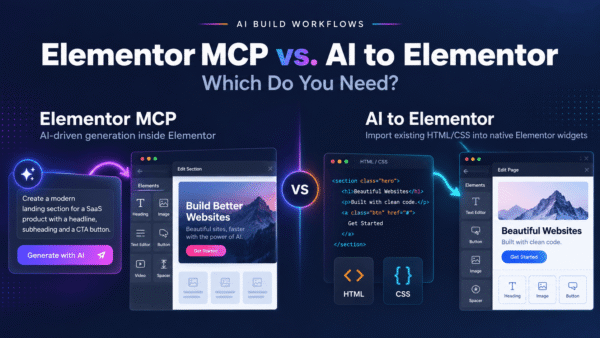
Elementor now has an official MCP integration, allowing tools such as Claude, Codex and Cursor to connect directly to WordPress and create or edit Elementor pages.
So if AI can now build directly inside Elementor, do you still need a tool such as AI to Elementor?
Yes — because the two tools solve different problems.
The simplest distinction is this:
Elementor MCP generates Elementor pages. AI to Elementor converts pages you already have into Elementor.
If you want to describe a website to an AI and have it build the page directly inside Elementor, MCP is designed for that.
If Claude, Lovable, Bolt, v0, Replit or another tool has already created the website you want, AI to Elementor is designed to take that finished HTML and CSS and convert it into editable Elementor widgets.
That distinction matters more than it might initially appear.
What Is Elementor MCP?
MCP stands for Model Context Protocol. It provides a way for an AI application to interact with another application through a defined set of tools.
Elementor’s MCP implementation allows compatible AI clients such as Claude Code, Claude Desktop, Codex and Cursor to connect directly to an Elementor website.
Instead of asking Claude to generate HTML that you later copy into WordPress, you can tell it something such as:
Create a landing page for a SaaS product with a hero section, features, pricing and FAQ.
The AI can then create the page using actual Elementor structures.
Elementor says its MCP can create Atomic layouts, work with classes and variables, edit existing elements, work with dynamic content and interact with site-level components.
The current implementation is available as a beta and uses Elementor’s Atomic Editor.
Official Elementor announcement: https://elementor.com/blog/elementor-mcp-beta/
That makes MCP particularly interesting for developers and agencies that want to use Claude or Codex as an AI operator for Elementor rather than simply as a code generator.
What Is AI to Elementor?
AI to Elementor solves almost the opposite problem.
Instead of asking AI to create the page inside WordPress, you create the design somewhere else first.
For example, you might build a landing page using:
- Claude
- Lovable
- v0
- Bolt
- Replit
- Blink
- Base44
- Google Stitch
- your own HTML and CSS
Once the design looks the way you want, AI to Elementor converts that existing HTML and CSS into native Elementor structure.
A heading becomes an Elementor heading.
A button becomes an Elementor button.
Images become Elementor image widgets.
Sections become Elementor containers.
The goal isn’t to ask another AI to redesign the page.
It is to translate the page you already approved into editable Elementor content.
And despite the name, the conversion itself isn’t performed by an LLM. AI to Elementor uses deterministic parsing rules to convert HTML and CSS into Elementor structure.
That difference is important.
Elementor MCP vs. AI to Elementor
Here is the practical comparison.
| Elementor MCP | AI to Elementor | |
|---|---|---|
| Main purpose | Generate or modify Elementor pages with AI | Convert existing HTML/CSS into Elementor |
| Starting point | A prompt, brief, file or other context | A finished HTML/CSS design |
| How the page is created | An AI model decides what to build | Conversion rules translate the existing page |
| Same result every time | Not necessarily | Yes, for the same supported input |
| AI tokens required | Yes | No tokens for the conversion |
| Claude / Codex integration | Direct | Create with them first, then import |
| Elementor Atomic Editor | Currently required for MCP beta | Not required |
| Elementor Free | Basic MCP capabilities are available, while Pro functionality requires Pro | Supported |
| Existing HTML/CSS | AI can use it as context and reconstruct it | Imported directly |
| Best use | Creating and iterating | Reproducing an existing design |
Elementor describes MCP as a way for external AI tools to build and modify real Elementor structure.
It can even use information from sources such as Figma or other files as context.
But the AI is still generating Elementor output from that context rather than performing a deterministic HTML-to-widget conversion.
And that leads to the most important difference between the two approaches.
Generation vs. Conversion
Imagine you have already created a landing page in Claude.
You spent an hour getting the typography right.
The spacing is right.
The client approved the layout.
The responsive design looks good.
Now you want it inside WordPress.
With Elementor MCP, you can give Claude access to Elementor and ask it to recreate that design.
Claude examines the source design and builds Elementor elements that attempt to reproduce it.
That can work very well.
But it is still a generation task.
With AI to Elementor, there is no second design process.
The existing HTML and CSS are the source of truth.
The converter reads them and builds the corresponding Elementor structure.
That’s the difference between:
“Rebuild this design for me.”
and:
“Convert this design for me.”
For some projects the first workflow is exactly what you want.
For others, the second makes much more sense.
When Elementor MCP Makes More Sense
Elementor MCP is particularly useful when the page doesn’t exist yet.
You can start with a brief and let Claude, Codex or another supported AI agent create the page directly inside WordPress.
It’s also powerful when you’re working heavily with Elementor’s newer Atomic Editor, because the AI can interact with structures such as classes, variables and reusable design-system elements.
Elementor also positions MCP as more than a page-generation tool.
AI applications can use context from other sources and then use that information while building inside Elementor.
That opens up some genuinely interesting workflows.
You could potentially give an AI a design brief, documentation, Figma context and information about the existing site, then ask it to build or modify Elementor pages from that context.
For ongoing AI-assisted development inside WordPress, MCP is the more powerful concept.
When AI to Elementor Makes More Sense
The situation changes when the page is already finished.
Perhaps you asked Claude to design it.
Or you built it visually in Lovable.
Or v0 created the frontend.
Or Bolt generated the landing page.
At that point, asking another AI process to reconstruct the page isn’t always necessary.
You already have the design.
You simply need to move it into Elementor.
This is where AI to Elementor fits.
Paste or upload the existing page, convert it, and continue editing it inside Elementor.
It is especially useful when the original design needs to remain the source of truth rather than becoming inspiration for another AI generation.
There is also no LLM involved in the conversion itself, so you aren’t spending Claude, OpenAI or other model tokens each time you convert a page.
What About Token Costs?
This is another important distinction.
Elementor MCP doesn’t provide the intelligence itself. Your connected AI tool does.
If you’re using Claude Code, Codex or another AI client, that model needs to analyse your request, inspect the existing structure, decide what Elementor operations are required and execute them.
Elementor confirms that the AI cost therefore depends on the AI service you connect to the MCP.
For occasional changes, that may be irrelevant.
For large sites or repeated page creation, it becomes part of the workflow cost.
AI to Elementor does not call an LLM during conversion, so there is no token cost per imported page.
The two approaches are therefore fundamentally different:
MCP spends AI compute to decide what Elementor should build.
AI to Elementor converts an already-decided design.
Do You Need Elementor Pro?
Not necessarily.
Elementor says basic MCP functionality can be used without Elementor Pro, while functionality involving Pro elements requires a Pro plan.
The current MCP beta also requires the Atomic Editor to be enabled.
AI to Elementor works with Elementor Free and does not require the Atomic Editor.
That may be relevant for existing sites that still use the traditional Elementor editing workflow.
Can Elementor MCP Import HTML?
This is where the terminology can become confusing.
You can give an AI agent HTML, a screenshot, a Figma design or another source and then ask it to use Elementor MCP to build something based on it.
Elementor specifically describes workflows where AI tools carry external context into Elementor.
But that isn’t quite the same thing as HTML import.
The AI reads the source and decides how to reconstruct it using the Elementor capabilities exposed through MCP.
An HTML importer works differently.
It interprets the existing DOM, CSS and assets and maps them into Elementor structures according to conversion rules.
So both workflows may start with the same HTML file but take very different routes:
HTML → AI interpretation → MCP operations → Elementor
versus:
HTML → converter → Elementor
That is probably the clearest way to understand the difference.
Can You Use Elementor MCP and AI to Elementor Together?
Yes — and for many developers this may actually be the best workflow.
You don’t have to choose one ecosystem.
Imagine this process:
Claude → HTML/CSS → AI to Elementor → Elementor → MCP
You use Claude, Lovable or another AI design tool to create the original page.
You keep iterating until the design is right.
Then you use AI to Elementor to convert the finished design into editable Elementor widgets.
Once the page is inside WordPress, you connect Elementor MCP and use Claude or Codex to continue working with it.
For example, you could ask the AI to:
- modify a section
- apply a design-system class
- create another page using the same structure
- connect elements to dynamic WordPress data
- create or modify site parts
In other words:
AI to Elementor gets the design into Elementor.
Elementor MCP can help you continue working on it once it’s there.
They are complementary rather than mutually exclusive.
What AI to Elementor Cannot Convert Perfectly
There are cases where importing HTML isn’t the right solution either.
JavaScript-driven applications are an obvious example.
A converter can reproduce markup and styling, but functionality generated dynamically by JavaScript may require additional work inside WordPress.
Complex application logic, advanced interactive components, forms connected to external services and framework-specific behaviour may also need to be rebuilt or connected manually.
The same applies to some modern CSS-framework output.
Clean HTML with standard CSS is much easier to translate into Elementor than highly framework-dependent markup.
Current limitations to be aware of include:
- Tailwind v4 output can be difficult to convert cleanly because of features such as OKLCH tokens,
@layerand@property. - JavaScript-generated components such as sliders, counters or theme switches may arrive only as static markup.
- Mobile column stacking may still need manual adjustment inside Elementor.
- Forms may convert as markup rather than Elementor Pro Form widgets.
- Structured content such as events or listings may require the relevant WordPress plugin.
That is why the best input for an HTML-to-Elementor workflow remains a clean frontend where the visual structure already exists in the HTML and CSS.
Elementor MCP or AI to Elementor: Which Should You Choose?
The decision is surprisingly simple.
If the page doesn’t exist yet and you want AI to build it inside Elementor, use Elementor MCP.
If the page already exists as HTML/CSS and you want to bring that design into Elementor, use AI to Elementor.
And if AI is already a major part of your web-design workflow, you may want both.
Design where AI design tools are strongest.
Convert the finished frontend into Elementor.
Then use MCP when you want an AI agent to continue creating, editing and managing the site from inside the Elementor ecosystem.
That gives you the advantages of AI-generated web design without forcing every stage of the process to use the same tool.
Frequently Asked Questions
What is Elementor MCP?
Elementor MCP is Elementor’s implementation of the Model Context Protocol.
It allows compatible AI tools such as Claude, Codex and Cursor to connect to a WordPress site and create or modify real Elementor structures.
The feature is currently available as a beta and is built around Elementor’s Atomic Editor.
Official Elementor announcement: https://elementor.com/blog/elementor-mcp-beta/
Is Elementor MCP the same as an HTML importer?
No.
MCP gives an AI agent tools for creating and editing Elementor content.
An AI can inspect HTML or another design source and then reconstruct it through MCP, but that is different from directly converting the existing HTML structure into Elementor widgets.
Can I use Claude with Elementor?
Yes.
Elementor lists Claude Code and Claude Desktop among the AI clients supported by its MCP beta.
Codex and Cursor are also supported.
Can I convert Claude HTML to Elementor?
Yes.
If Claude has already generated your HTML and CSS, AI to Elementor can convert that frontend into editable Elementor structure rather than asking Claude to recreate the design through prompts.
Does AI to Elementor use AI to perform the conversion?
No.
The conversion engine uses deterministic parsing rather than an LLM.
That means the same supported HTML produces the same conversion instead of a new AI interpretation on every run.
Do I need Elementor Pro?
AI to Elementor works with Elementor Free.
Elementor MCP also provides basic functionality without Pro, although Pro elements require an Elementor Pro plan.
Try AI to Elementor
Already built your page with Claude, Lovable, v0, Bolt, Replit or another AI website builder?
Don’t rebuild it from scratch.
Convert the existing HTML and CSS into native, editable Elementor widgets and continue working on the page inside WordPress.
Install AI to Elementor free — your first conversion requires no account or API key.
Install free on WordPress.org
1 conversion per site, no sign-up. Elementor required (free version is fine).